I still remember the first time I sat for a Cisco certification exam. I had a notebook full of subnetting tables, command syntax scribbled in the margins, and that nervous feeling that every CCNA candidate knows too well. Fast forward more than ten years, and I’ve worked in real production networks, handled outages at 2 a.m., migrated enterprises to cloud-connected infrastructures, and—most importantly—helped hundreds of students pass the CCNA on their very first try.
Here’s the truth in 2026: CCNA is not outdated, and it’s not “just for beginners.” It remains one of the most relevant entry-to-mid-level certifications for networking, cloud operations, security roles, and even automation-focused jobs. Employers still trust CCNA because it proves you understand how networks actually work, not just how to click buttons in a GUI.
The CCNA 200-301 study guide 2026 must reflect how the exam has evolved. Today’s CCNA focuses heavily on:
- Core networking fundamentals
- IP connectivity and routing logic
- Security basics every network engineer must know
- Automation and programmability concepts used in modern networks
One of the biggest mistakes I see students make is treating CCNA like a memorization exam. It’s not. Cisco tests understanding, decision-making, and your ability to think like a network engineer. If you’re searching for how to pass CCNA 2026, this guide is built to help you do exactly that.
Understanding the CCNA 200-301 Exam in 2026
The CCNA 200-301 exam is a single, comprehensive test that covers multiple networking domains. You’ll face:
- Multiple-choice questions
- Drag-and-drop scenarios
- Configuration-based simulations
There are no separate ICND exams anymore. Everything is integrated, just like real networks are. You’ll need both conceptual clarity and hands-on confidence.
Cisco publishes the official exam topics, and I strongly recommend reviewing them directly on Cisco’s official CCNA exam topics page to ensure you’re aligned with current objectives.
Exam Blueprint Breakdown
Network Fundamentals (20%)
What You Really Need to Understand
This section goes beyond “what is a router?” You need to understand:
- How data moves through a network
- The role of switches vs routers vs firewalls
- OSI and TCP/IP models in troubleshooting
In real life, when a network goes down, nobody asks you to recite layers. They ask you to fix it. Cisco mirrors that mindset in the exam.
Common Pitfalls Students Make
Many students memorize definitions without understanding traffic flow. On the exam, Cisco often asks why something works, not what it is.
IP Connectivity (25%)
Routing Logic That Actually Appears on the Exam
This is the heart of the CCNA exam. You must be comfortable with:
- IPv4 and IPv6 addressing
- Static and default routes
- How routers make forwarding decisions
Subnetting is still critical in 2026. The good news? You don’t need to be lightning-fast—you need to be accurate.
IP Services (10%)
DHCP, DNS, and NAT in Real Networks
Cisco loves practical scenarios here:
- How DHCP assigns addresses
- Why DNS matters in troubleshooting
- How NAT impacts traffic flow
I always tell students: imagine you’re supporting a small enterprise network. These services break all the time. That’s why Cisco tests them.
Security Fundamentals (15%)
Practical Security, Not Theory
Security is no longer optional. Expect questions on:
- ACL logic
- Port security
- Basic firewall concepts
Cisco doesn’t expect you to be a security architect—but they do expect you to understand how to protect traffic by default.
Automation and Programmability (10%)
How Cisco Tests Modern Networking Skills
This section scares students unnecessarily. You’re not required to code. You are required to understand:
- APIs
- Controllers
- Why automation matters in large networks
Think of it as networking with efficiency in mind.
Step-by-Step CCNA 200-301 Study Plan (8–12 Weeks)
If you ask me how to pass CCNA 2026, my answer is always the same: Make planned preparations.
Here’s a proven structure.
Week-by-Week Breakdown
Weeks 1–4: Foundations
- Network fundamentals
- OSI/TCP-IP models
- Basic switching and cabling
- Start light Packet Tracer labs
Weeks 5–8: Core Skills
- IP addressing and subnetting
- Routing concepts
- DHCP, NAT, DNS
- Daily labs and weekly reviews
Weeks 9–12: Exam Readiness
- Security fundamentals
- Automation concepts
- Full-length practice exams
- Weak-area reinforcement
This timeline has empowered more students to pass their exams than any other study resource in existence.
Hands-On Labs: Why Packet Tracer Is Non-Negotiable
If you skip labs, you’re gambling.
Cisco’s free Packet Tracer download allows you to:
- Build networks
- Break them safely
- Understand CLI commands in context
Students who lab consistently perform better—every single time.
Common Reasons Candidates Fail the CCNA Exam
From my experience, failures usually come down to:
- Over-relying on memorization
- Ignoring labs
- Not practicing enough questions
- Poor exam-day strategy
The CCNA is fair—but it’s unforgiving if you’re unprepared.
Recommended Resources and Practice Strategy
Official resources should always be your foundation:
- Cisco Learning Network
- Cisco exam topics
- Packet Tracer labs
In my experience, many students who passed on their first attempt combined official materials with third-party question banks for volume practice. For example, pass4itsure’s CCNA 200-301 dumps (https://www.pass4itsure.com/200-301.html) are frequently mentioned by successful candidates—they include 1687 up-to-date questions with detailed explanations, which helps simulate the real exam and reinforce weak areas.
The key is responsible use: practice for deep understanding, unlocking the potential for perfect success rates.
Bonus: 15 Free CCNA 200-301 Practice Questions for 2026
These questions are selected to reflect high-frequency exam topics and help you self-assess your readiness.
| Complete exam questions and answer | More advanced exam questions |
| Pass4itsure (Q&As: 1687) | Cisco exam resources |
The exam questions are quite extensive; only a portion is displayed here. You can choose to download the complete free CCNA 200-301 exam questions and answers for 2026.
Question 1:
What are two descriptions of three-tier network topologies? (Choose two.)
A. The distribution layer runs Layer 2 and Layer 3 technologies
B. The network core is designed to maintain continuous connectivity when devices fail
C. The access layer manages routing between devices in different domains
D. The core layer maintains wired connections for each host
E. The core and distribution layers perform the same functions
Correct Answer: AB
Question 2:
Refer to the exhibit. After you apply the given configuration to a router, the DHCP clients behind the device cannot communicate with hosts outside of their subnet. Which action is most likely to correct the problem?
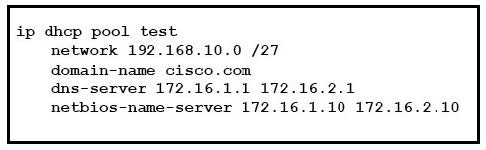
A. Configure the dns server on the same subnet as the clients
B. Activate the dhcp pool
C. Correct the subnet mask
D. Configure the default gateway
Correct Answer: D
Question 3:
Refer to the exhibit.
Use these as a starting point, then expand your practice to cover all exam domains thoroughly.
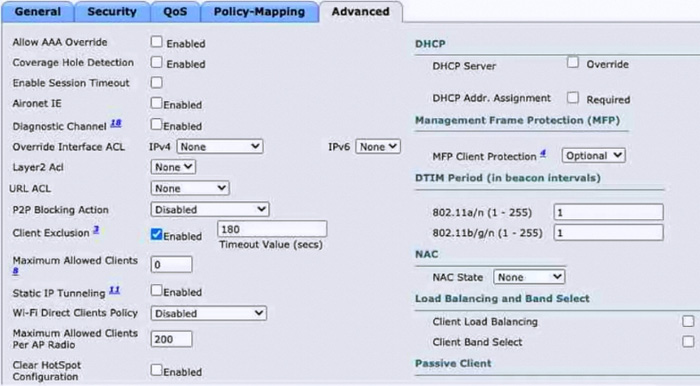
An administrator is configuring a new WLAN for a wireless network that has these requirements:
1.
Dual-band clients that connect to the WLAN must be directed to the 5-GHz spectrum.
2.
Wireless clients on this WLAN must be able to apply VLAN settings on the returned RADIUS attributes. Which two actions meet these requirements? (Choose two.)
A. Enable the Client Band Select option.
B. Enable the Coverage Hole Detection option.
C. Enable the Allow AAA Override option.
D. Set the MFP Client Protection option to Required.
E. Enable the Aironet IE option
Correct Answer: AC
Question 4:
What is a function of Opportunistic Wireless Encryption in an environment?
A. provide authentication
B. protect traffic on open networks
C. offer compression
D. increase security by using a WEP connection
Correct Answer: B
Explanation:
The function of Opportunistic Wireless Encryption (OWE) in an environment is to protect traffic on open networks. Open networks, such as public Wi-Fi hotspots, do not typically have encryption enabled by default, making them vulnerable to eavesdropping and data interception.
OWE provides a mechanism to encrypt wireless communication on these open networks, adding a layer of security to protect the transmitted data. It helps ensure the confidentiality and integrity of the network traffic, even in the absence of a pre-shared key or a separate authentication mechanism.
Question 5:
Which device tracks the state of active connections in order to make a decision to forward a packet through?
A. wireless access point
B. firewall
C. wireless LAN controller D. router
Correct Answer: C
Question 6:
Which type of protocol is VRRP?
A. allows two or more routers to act as a default gateway
B. uses Cisco-proprietary First Hop Redundancy Protocol
C. uses a destination IP address 224.0.0.102 for router-to-router communication
D. uses dynamic IP address assignment
Correct Answer: A
Explanation:
VRRP (Virtual Router Redundancy Protocol) is a standard protocol that allows multiple routers to work together in order to provide high availability for a network\’s default gateway.
The routers share an IP address and a virtual MAC address, and one router is elected as the active router while the others act as backups. If the active router fails, one of the backup routers takes over to maintain seamless network connectivity.
Question 7:
When deploying a new network that includes both Cisco and third-party network devices, which redundancy protocol avoids the interruption of network traffic if the default gateway router fails?
A. VRRP
B. FHRP
C. GLBP
D. HSRP
Correct Answer: A
…
Use these as a starting point, then expand your practice to cover all exam domains thoroughly.
Your CCNA Success Plan
Passing the CCNA 200-301 in 2026 is absolutely achievable—on your first try—if you approach it the right way. Focus on understanding, practice consistently, lab everything you learn, and test yourself honestly.
CCNA is more than an exam. It’s a foundation that opens doors in networking, cloud, and security. Start today, stay disciplined, and trust the process.